
How much protein per day when you train?
By Franck Berthelot9 min read
ANSES, the French food safety agency, and the European Food Safety Authority (EFSA) set the reference intake at 0.83 g of protein per kilo of body weight per day for a healthy adult, which is 58 g for someone weighing 70 kg. If you train, the International Society of Sports Nutrition (ISSN) puts how much protein per day you need at 1.4 to 2 g/kg. A meta-analysis of 49 studies places the ceiling for muscle gains at around 1.6 g/kg, with a margin up to 2.2 g/kg.
How much protein per day does an adult need?
The French reference is 0.83 g of protein per kilo of body weight per day. ANSES set it in 2007 for healthy adults. EFSA uses the same value for the whole of Europe, older adults included. In 2016 ANSES added a second guideline, which says protein should provide 10 to 20% of an adult's total energy intake.
This figure covers maintenance needs. EFSA calculates it as the amount that keeps a healthy adult in nitrogen balance, meaning what you need to replace the protein your body loses each day. At 60 kg that comes to 50 g; at 80 kg, 66 g.
In Europe, average adult intake often meets this reference or goes beyond it. EFSA reports average intakes of 67 to 114 g a day in men and 59 to 102 g in women. The question changes once you train three or four times a week and want to build or keep muscle.
How much protein do you need to build muscle?
For strength training, the ISSN considers 1.4 to 2 g of protein per kilo per day enough for most people who train. The figure applies to gaining muscle and to keeping it. It is the society's official position stand, published in 2017.
The meta-analysis by Morton and colleagues, published in 2018 in the British Journal of Sports Medicine, pools 49 trials and 1,863 participants. Above a total intake of 1.62 g/kg a day, extra protein produced no further gain in lean mass. The confidence interval for this threshold runs from 1.03 to 2.20 g/kg, and the authors consider it prudent to aim for about 2.2 g/kg if you are after the maximum gain.
The same study adds two useful details. The effect of extra protein shrinks with age, and it is stronger in people who already train. The meal plans in the 6way app sit within this range, with 2 g/kg for muscle gain.
How much protein per day for your body weight?
The table gives daily intakes for six body weights, calculated from the guidelines above and rounded to the nearest gram. Find the row for your weight, then the column that matches how you train.
| Weight | Adult, maintenance (0.83 g/kg) | Training (1.4 to 2 g/kg) | Morton plateau (1.6 g/kg) | Top of the range (2.2 g/kg) | Per meal, over 4 meals (0.4 g/kg) |
|---|---|---|---|---|---|
| 50 kg | 42 g | 70 to 100 g | 80 g | 110 g | 20 g |
| 60 kg | 50 g | 84 to 120 g | 96 g | 132 g | 24 g |
| 70 kg | 58 g | 98 to 140 g | 112 g | 154 g | 28 g |
| 80 kg | 66 g | 112 to 160 g | 128 g | 176 g | 32 g |
| 90 kg | 75 g | 126 to 180 g | 144 g | 198 g | 36 g |
| 100 kg | 83 g | 140 to 200 g | 160 g | 220 g | 40 g |
Column sources: ANSES, ISSN, Morton, and Schoenfeld and Aragon for the split across meals. Multiply the last column by four meals and you get back to 1.6 g/kg a day.
How much protein to lose weight without losing muscle?
In a calorie deficit, needs go up. The ISSN states that 2.3 to 3.1 g/kg a day may be needed for trained lifters to keep as much lean mass as possible.
The same range appears in the review by Eric Helms and colleagues, published in 2014. Helms expresses it per kilo of lean mass, meaning body weight minus fat, and raises it as the deficit gets more severe and the athlete gets leaner. For someone weighing 80 kg at 20% body fat, lean mass is 64 kg, and the range gives 147 to 198 g a day.
The review rests on six studies of adults with more than six months of training, with at most 23% body fat for men and 35% for women. In 6way, the Lean cut meal plan sets 2.2 g/kg of body weight. That is 176 g at 80 kg, inside the 147 to 198 g range calculated above.
Does a woman need less protein than a man?
The per-kilo guideline is the same for women and men. EFSA sets a single value for adults, 0.83 g/kg a day, and ANSES refers to healthy adults without separating the sexes. The ISSN's ranges for sport are also expressed per kilo of body weight.
The gap in grams comes from body weight. A 60 kg woman who lifts weights aims for 84 to 120 g a day, and an 80 kg man for 112 to 160 g. Average intakes recorded in Europe follow the same pattern, with 59 to 102 g a day for women and 67 to 114 g for men.
Needs change during pregnancy and breastfeeding, so ask your doctor or midwife.
How much protein after 65?
For people over 65, the international PROT-AGE expert group, convened by the European Union Geriatric Medicine Society, recommends at least 1 to 1.2 g of protein per kilo per day. It advises 1.2 g/kg or more for people who exercise or stay active. At 70 kg that comes to 70 to 84 g a day.
EFSA keeps 0.83 g/kg for older adults. The two figures answer different questions. PROT-AGE sets out to help people over 65 keep or regain their muscle mass and physical function.
Two study results point the same way. In Morton's meta-analysis, the effect of extra protein on lean mass shrinks with age. A study cited by the ISSN followed men with an average age of 71 after a leg workout. They needed 40 g of whey protein per serving to get the maximum rise in muscle protein synthesis.
If you have kidney disease, agree your protein intake with your doctor.
How should you spread protein across the day?
The ISSN advises servings of 20 to 40 g, or 0.25 g per kilo, every 3 to 4 hours. For building muscle, Schoenfeld and Aragon proposed a simple rule in 2018 of 0.4 g/kg per meal over at least four meals. That brings the total to 1.6 g/kg a day. At 2.2 g/kg a day over four meals, each serving goes up to 0.55 g/kg at most.
At 70 kg, that means 28 to 39 g per meal. A typical day has a breakfast, lunch, snack and dinner that each include a portion of protein.
The daily total matters more than the exact time you eat. According to the ISSN, the main benefit of protein around a workout is the extra chance to eat, which raises the day's intake. In the evening, 30 to 40 g of casein before bed increases muscle protein synthesis overnight.
What 6way does for your protein target
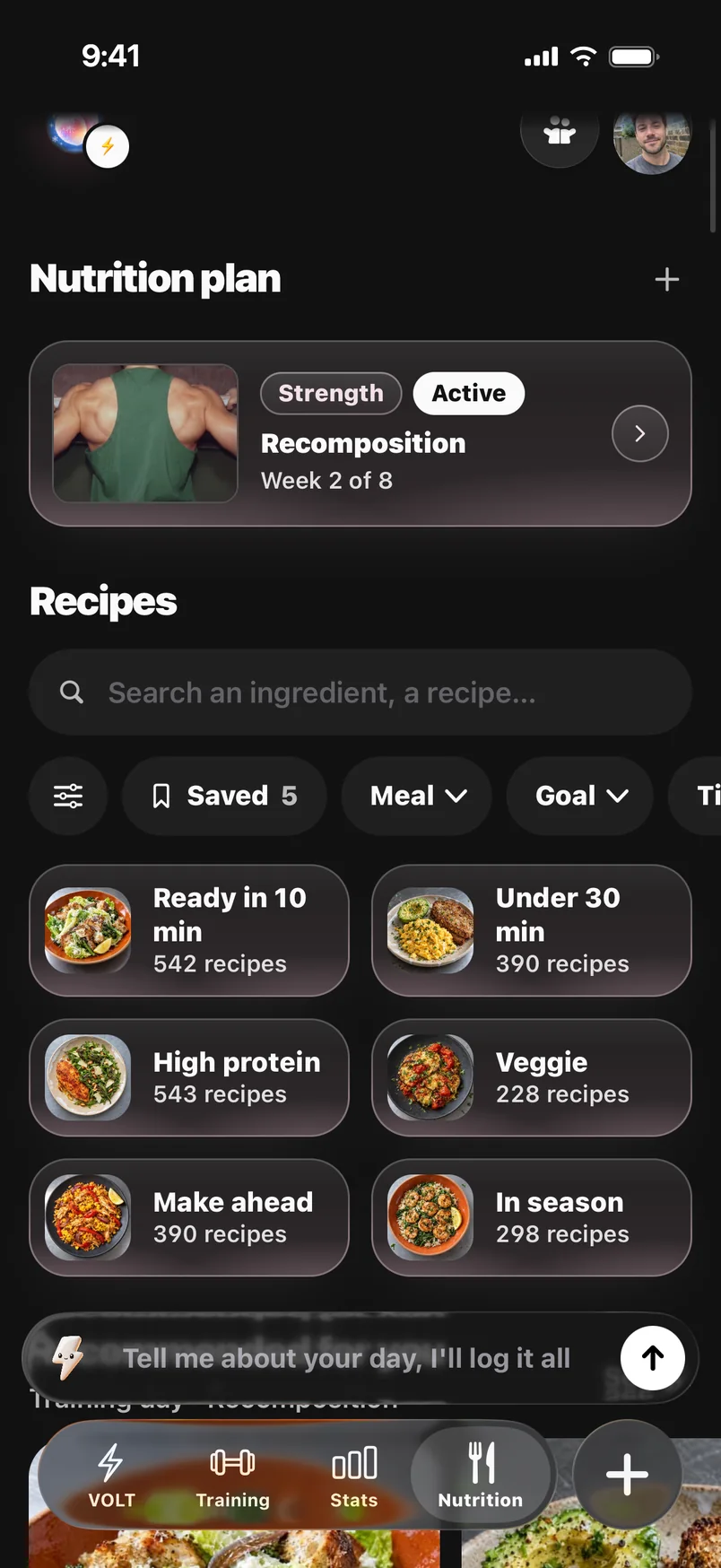
6way is a sports coaching and nutrition app. Your programs, your logged meals and VOLT all work from the same protein target. As soon as you choose a meal plan, it sets that target. The app multiplies the plan's figure by your body weight and rounds it to the nearest 5 g.
| 6way meal plan | Protein per kilo | At 70 kg |
|---|---|---|
| Lean cut | 2.2 g | 155 g |
| Lean muscle gain | 2 g | 140 g |
| Recomposition | 2 g | 140 g |
| Maintenance and performance | 1.8 g | 125 g |
| Race prep | 1.7 g | 120 g |
These targets run from 1.7 to 2.2 g/kg, which covers the ISSN range and goes up to the prudent 2.2 g/kg figure from Morton. The app's method page cites its two sources, Helms 2014 and Morton 2018.
Your protein target stays the same every day. Calories and carbs follow the day's workout. On Recomposition, the calorie target goes up by 250 kcal on a heavy training day and down by 200 on a rest day.
You tell VOLT, 6way's coach about your meals in a sentence or a photo. It breaks each meal down into foods and logs the protein in each one, using Ciqual, the ANSES food composition table. It knows what you have already eaten that day and how many grams you have left. A day counts as a success once you reach 90% of your protein target. If you are 30 g short in the evening, VOLT looks for a recipe in the app with at least the amount of protein per serving you give it. If your goal changes, tell VOLT and it will create the new meal plan. Download 6way to get a target calculated from your body weight.
Frequently asked questions
ANSES could not set any safe upper limit for protein intake because there was not enough data. The ISSN notes that no controlled scientific evidence shows a health risk from high intakes in healthy people who train. The guidelines in this article apply to healthy adults. If you have an illness, particularly kidney disease, agree your protein intake with your doctor.
The ISSN advises looking first to whole foods that provide good-quality protein with all the essential amino acids. Meat, fish, eggs and dairy are among them, and pulses add to the total. The ISSN describes powder supplements as a safe and convenient way to add more. Powder is mainly useful when your meals fall short of the day's target, on a travel day for example. The number that counts is still the daily total, whatever the source.
Yes. EFSA's reference intakes apply to a mix of animal and plant proteins. ANSES points out that cereals are low in lysine and pulses are low in sulphur amino acids. It does not consider it necessary to combine cereals and pulses at every meal, because protein sources in France are varied enough. Varying your sources over the day is enough.
There is no need to rush. According to the ISSN, muscle protein synthesis peaks within three hours of the workout and stays raised for 24 to 72 hours. The post-workout meal matters mainly because it adds a serving of protein to the day. A lunch or dinner within two or three hours works. If your workout falls a long way from a meal, a snack with 20 to 40 g of protein does the job.
The ISSN range of 1.4 to 2 g/kg a day applies to most people who train, runners included. At 60 kg that is 84 to 120 g. The 6way Race prep meal plan sets 1.7 g/kg. One of its rules is 30 to 40 g of protein within 2 hours of a run, with carbs. During race preparation, calories go up by 300 kcal on run days and the protein target stays the same.