
Body recomposition: can you lose fat and build muscle at the same time?
By Franck Berthelot9 min read
You can lose fat and build muscle at the same time. The effect is clearest in beginners and people carrying extra weight, and smaller in trained athletes. Body recomposition rests on four levers: strength training that progresses, 1.6 to 2.4 g of protein per kilo per day, calories at your maintenance or 10 to 20% below, and full nights of sleep. Track your waist, your lifts and progress photos instead of watching the scales.
Who does body recomposition work for?
It is possible for adults who lift weights and eat enough protein, and how far it goes depends on the person. A 2026 review in the Journal of the International Society of Sports Nutrition sums it up. The effects are strongest in untrained people and in those with more body fat, and weaker in trained or lean athletes. It is still possible after 60, with supervised strength training and enough protein.
Beginners have the most room to progress, including people coming back after at least a year without regular strength training. So do people who are overweight. In a trial of 90 overweight or obese women, the high-protein group gained lean tissue and lost fat.
Trained athletes are not left out. A review by Barakat and colleagues (2020) points to a substantial body of research showing recomposition in trained lifters.
Does body recomposition work for women?
Yes. The 2026 review concludes that neither sex has a consistent advantage for recomposition when training and protein intake are the same. Men often gain more muscle in absolute terms, and women make progress too.
Three studies run only in women show it at different ages.
- Young trained women: 17 participants, 8 weeks of strength training. At 2.5 g of protein per kilo, lean mass rose by 2.1 kg, against 0.6 kg at 0.9 g per kilo. Fat mass went from 14.1 to 13.0 kg (Campbell, 2018).
- Overweight premenopausal women: 16 weeks of diet and exercise, with a gain in lean tissue in the high-protein group.
- Untrained women with an average age of 69: 24 weeks of strength training, with muscle gains in all three groups of the analysis (Ribeiro, 2022).
How much protein per day for body recomposition?
Aim for 1.6 to 2.4 g of protein per kilo of body weight per day, split into meals of 0.3 to 0.5 g per kilo. For someone who weighs 75 kg, that comes to 120 to 180 g a day.
The bottom of that range is a measured threshold. A meta-analysis of 49 studies and 1,863 participants found no further gain in lean mass above 1.62 g per kilo per day. The ISSN position stand on protein considers 1.4 to 2.0 g per kilo enough for most athletes who want to build or keep muscle.
The top of the range is for when you are already lean or in a calorie deficit.
Should you eat at maintenance or in a small deficit?
Both work, and the right choice depends on how much body fat you start with. The 2026 review suggests staying 10 to 20% below maintenance. In trained people, weight loss should not go beyond 0.5 to 0.7% a week. For trained athletes, the review also mentions eating around maintenance, higher on some days and lower on others (±5 to 10%).
The ISSN position stand on diets sets out the logic. The more body fat you start with, the bigger the deficit can be. Leaner people hold on to more muscle with slow weight loss. The 2026 review adds that in trained people, a deficit of around 500 kcal a day can wipe out the gain in lean mass.
How you spread calories across the week matters too. A little more carbohydrate on hard training days supports intensity and helps you keep lean mass.
Which training program for body recomposition?
A strength program where the load or the volume goes up week after week. Barakat and colleagues rank this progression, together with evidence-based nutrition, as the first factor in recomposition. The 2026 review recommends the same base: progressive overload, protein at the centre of each meal, a modest deficit and regular tracking of body composition and performance.
Three workouts a week were enough in the analysis of 69-year-old women. The program had eight full-body exercises, three sets of 8 to 15 reps, three times a week. Lifters who are already trained have less room to progress, and the 2026 review asks them for high-quality strength training and careful management of fatigue.
Does sleep change the result?
Yes, at least during a calorie deficit. In a trial published in the Annals of Internal Medicine, 10 overweight adults followed the same moderate 14-day diet twice. They spent 8.5 hours in bed a night during one period and 5.5 hours during the other. With the short nights, the share of fat in the weight they lost fell by 55% and the loss of lean mass rose by 60%.
The participants did no strength training, which limits how far the result applies. Even so, the 2026 review concludes that enough good-quality sleep appears to help recomposition. Protect your nights as you protect your workouts.
How long does body recomposition take?
Plan for several months. The trials cited here measure recomposition over 8 to 24 weeks. The 2026 review gives the changes you can expect over 12 to 16 weeks.
| Profile | Lean mass over 12 to 16 weeks | Fat mass over 12 to 16 weeks |
|---|---|---|
| Beginner | +1 to +3 kg | −2 to −6 kg |
| High body fat (20% or more in men, 30% or more in women) | 0 to +3 kg | −4 to −10 kg |
| Trained athlete | 0 to +1.5 kg | −1 to −3 kg |
These figures describe typical responses, with consistent strength training, enough sleep and a diet you stick to. A trained athlete moves more slowly, and half a kilo of lean mass over three months already counts.
How do you measure body recomposition without relying on the scales?
Your weight can stay the same while lean mass goes up and fat goes down, so the scales alone are not enough. The 2026 review advises checking body composition against strength, performance, waist measurement, sleep and appetite.
Four measures are enough at home.
- Your waist, at the same spot, in the morning, once a week.
- The weights on your main lifts. Weights going up while your waist goes down is the sign you are looking for.
- Progress photos from the front, side and back, with the same light and the same distance. The 2026 review lists them among the tracking methods that need more study, alongside weigh-ins and scans.
- Your average weight for the week, which smooths out day-to-day swings in water.
Bioimpedance scales and skinfold measurements give an estimate of body fat that is not precise enough for small individual changes. Read them as a trend, alongside the other three measures. If you have an illness, are pregnant or are injured, ask your doctor before changing your diet or training.
What 6way does for body recomposition
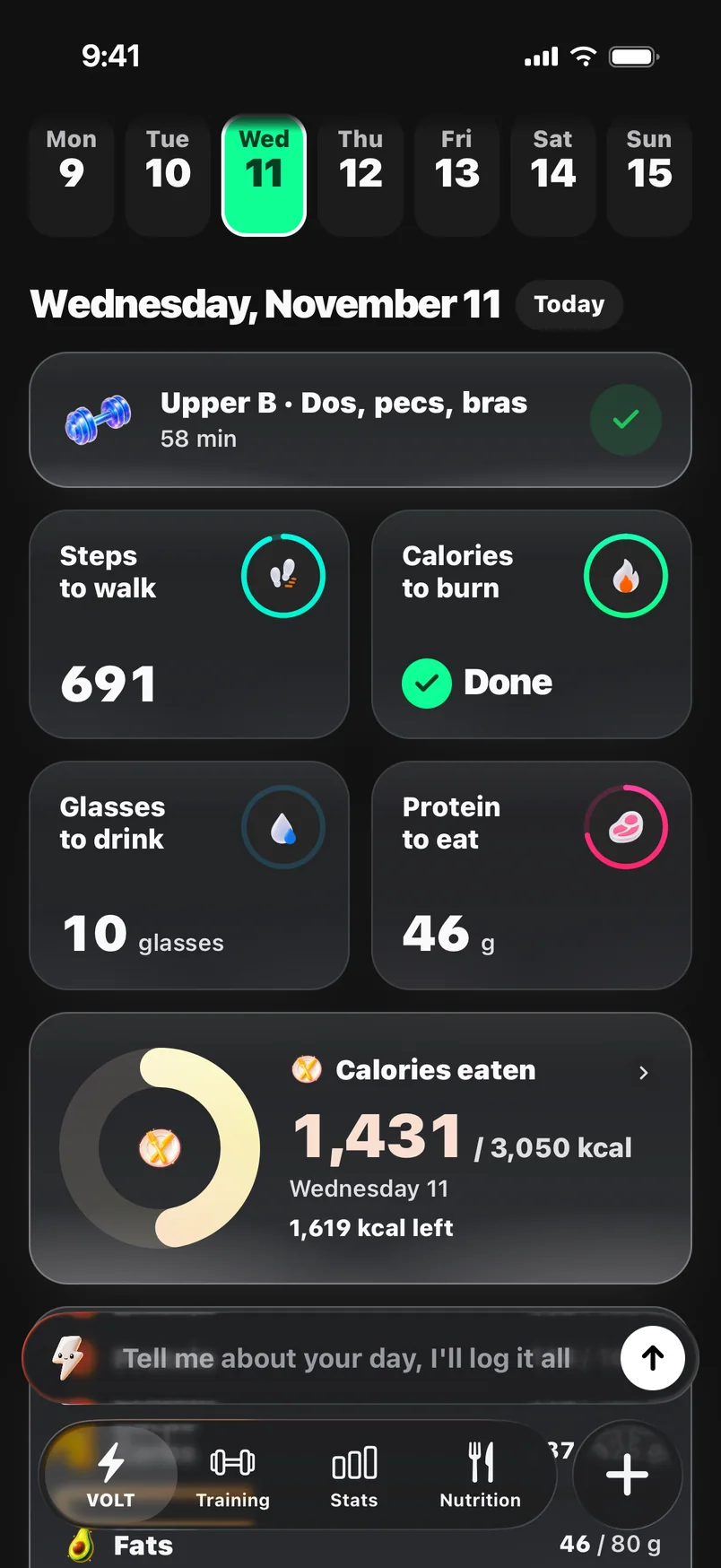
In the 6way app, "Lose fat and build muscle" is a goal you can pick from the very first questionnaire.
The Recomposition meal plan lasts 8 weeks and can be renewed: 2 weeks to get started, then 6 weeks of recomposition. At the end, the app suggests what comes next, and two cycles cover the 12 to 16 weeks in the figures above. Calories follow your estimated expenditure, with 250 kcal more on a heavy workout day and 200 kcal less on a rest day. Protein is set at 2 g per kilo, within the 1.6 to 2.4 g range above, and only carbohydrate changes with the day's workout. For someone who weighs 75 kg and burns 2,400 kcal, the daily target looks like this.
| Day | Calories | Protein | Carbohydrate |
|---|---|---|---|
| Heavy workout | 2,650 kcal | 150 g | 345 g |
| Endurance | 2,550 kcal | 150 g | 320 g |
| Light workout | 2,500 kcal | 150 g | 305 g |
| Rest day | 2,200 kcal | 150 g | 230 g |
With three heavy workouts and four rest days, the weekly total comes out 50 kcal below expenditure. After two weeks of weigh-ins, the app compares your weight from one week to the next. If it moves by 0.35 kg a week or more, the app adjusts the target by 100 kcal and tells you why. If you have more fat to lose, the Lean cut plan starts 15% below expenditure with 2.2 g of protein per kilo, near the top of that range.
For training, you describe your workout to VOLT and it logs your sets, weights and effort. Every Sunday evening, the app reviews the week you have done and adjusts the next one. Effort that runs too high removes a set, and a workout that was too easy adds weight. Your weight comes in from Apple Health, and the "Your body" page sorts your progress photos by date, with each one opening full screen at a tap.
Frequently asked questions
Yes. In the trial by Antonio and colleagues on 48 trained men and women, the group eating 3.4 g of protein per kilo kept a stable weight (−0.1 kg on average). That group still lost 1.7 kg of fat and gained 1.5 kg of lean mass. The scales showed almost nothing. Your waist, your lifts and your photos show this kind of change better than weight alone.
It is recomposition where calories change from day to day: more on training days, less on rest days, with an average close to maintenance over the week. The 2026 review notes that a little more carbohydrate on hard training days supports intensity and lean mass. For trained athletes, it mentions eating that swings 5 to 10% either side of maintenance. The 6way Recomposition plan follows this pattern, with a 450 kcal gap between a heavy workout day and a rest day.
Yes. The 2026 review considers it achievable in older adults, with supervised strength training and enough protein. In the analysis by Ribeiro and colleagues, 130 untrained women with an average age of 69 did 24 weeks of strength training, three workouts a week. All three groups gained muscle, and the group eating the least protein gained less. After 60, the review expects 0 to 1 kg of lean mass gained and 1 to 3 kg of fat lost over 12 to 16 weeks.
Look at the other measures first. A stable weight with a shrinking waist and rising lifts means recomposition is under way. If your waist and lifts also stall for two weeks running, check three things: your protein, how regularly you train and how many hours you sleep. In 6way, the app corrects the calorie target of the Recomposition plan by itself when your weight drifts by 0.35 kg a week or more. As long as your waist is going down and your lifts are going up, stay the course.
Cardio helps, on top of strength training. The 2026 review reports that combining strength and endurance training does the most for body composition. Everyday walking counts too. For a recomposition goal, 6way starts from a baseline of 8,000 steps a day (7,000 for a beginner) and adds 2,000 on days without a workout. Keep strength training at the centre of your week, because it gives muscle the mechanical tension that makes it grow.