
Half marathon training plan: the phases, the weeks and the paces
By Franck Berthelot8 min read
A half marathon training plan usually lasts 10 to 16 weeks. It has four stages: an endurance base, threshold work and work at maximal aerobic speed (MAS), race-pace work, then a two-week taper. Outside deload weeks, volume goes up by 10% a week at most, and it drops back every four weeks. For a 2-hour finish, race pace is 5:41 per kilometre.
How many weeks do you need to train for a half marathon?
Allow 10 to 16 weeks. That is the range 6way's plan generator uses for a half marathon. The table further down sets out a 12-week plan.
Starting volume depends on your level. A beginner starts at around 20 km a week and builds towards 40 km. An intermediate runner starts at 30 km and reaches 55 km. An experienced runner goes from 50 to 70 km. If you already run more than that, the plan starts from your current volume.
For a race that is months away, the app builds a longer base, up to 26 weeks. With less than four weeks to go, VOLT writes a short taper plan.
What are the phases of a half marathon plan?
A half marathon plan runs through four phases, each with its own kind of work. The shares below come from the standard plan, rounded to whole weeks. Over 12 weeks, that gives 3, 4 and 3 weeks before the taper.
- Base (about 40% of the weeks before the taper): slow easy runs, short hill reps and strength work.
- Build (35%): threshold workouts alternate with MAS workouts, and the long run gets longer.
- Race-specific phase (25%): race pace goes into the key workouts and into the last third of the long run.
- Taper: two lighter weeks, the second one being race week.
In every phase, most of your kilometres are run slowly. Among national and international-level endurance athletes, about 80% of training sessions are done at low intensity. The remaining 20% include hard work, according to Stephen Seiler's review. In a nine-week study of 48 well-trained athletes, the polarised group had the biggest rise in VO2peak, at 11.7%. 6way's generator follows this principle: easy runs and the bulk of the long run are done in zone 2.
What does a 12-week half marathon plan look like?
The table below follows 6way's generator rules for an intermediate runner starting from 30 km a week. This runner trains four times a week, with two quality workouts.
| Week | Phase | Volume (km) | Long run (km) |
|---|---|---|---|
| 1 | Base | 30 | 12 |
| 2 | Base | 33 | 12.9 |
| 3 | Base | 36.3 | 13.8 |
| 4 | Build (deload) | 29.5 | 11.7 |
| 5 | Build | 42.5 | 15.6 |
| 6 | Build | 45.6 | 16.4 |
| 7 | Build | 48.8 | 17.3 |
| 8 | Race-specific (deload) | 38.9 | 14.6 |
| 9 | Race-specific | 55 | 19.1 |
| 10 | Race-specific | 55 | 20 |
| 11 | Taper | 41.3 | 13.5 |
| 12 | Race week | 27.5 | the race |
Three rules produce these figures. The reference volume goes up by 10% a week at most. Every fourth week drops to 75% of that reference so your body can absorb the work, and the plan picks up its progression again the week after. The long run climbs from 12 to 20 km, never more than half the week's volume, and loses 20% in a deload week.
Quality workouts change with the phase. In the base phase they are short 30-second hill reps. In the build phase, threshold blocks alternate with 400 m repeats at MAS. In the race-specific phase, the key workout strings together two or three blocks of 3 to 5 km at half marathon pace.
How much should you increase your weekly mileage?
Increase your volume by 10% a week at most. The generator applies that cap to every plan, except when coming back from a deload week.
The cap fits with a Danish study that followed 874 novice runners for a year. Those who increased their distance by more than 30% over two weeks appeared more prone to distance-related injuries than those who stayed under 10%. The authors describe their study as exploratory and call for trials to confirm the link.
If a pain persists or changes the way you run, see a doctor before you carry on building up.
What pace should you aim for in a 2 h, 1 h 45 or 1 h 30 half marathon?
Race pace comes from your target time and the 21.0975 km of the distance. 6way's generator sets half marathon pace at 84 to 88% of MAS. The last column gives an easy-run range in zone 2, calculated at 65 to 75% of the midpoint of the guide MAS.
| Target | Race pace | Speed | Guide MAS | Easy run (zone 2) |
|---|---|---|---|---|
| 2 h | 5:41 /km | 10.55 km/h | 12.0 to 12.6 km/h | 6:31 to 7:32 /km |
| 1 h 50 | 5:13 /km | 11.51 km/h | 13.1 to 13.7 km/h | 5:59 to 6:54 /km |
| 1 h 45 | 4:59 /km | 12.06 km/h | 13.7 to 14.4 km/h | 5:42 to 6:35 /km |
| 1 h 40 | 4:44 /km | 12.66 km/h | 14.4 to 15.1 km/h | 5:26 to 6:16 /km |
| 1 h 30 | 4:16 /km | 14.07 km/h | 16.0 to 16.7 km/h | 4:53 to 5:39 /km |
If your measured MAS is below the range for your target, train on the row above. A recent 5 km, 10 km or half marathon time also works as a reference. The app converts it into MAS, then into paces for each zone.
Most race-pace work happens in the race-specific phase. The last third of the long run is then done at half marathon pace, on legs that are already tired, as they will be late in the race.
What should you do when you miss a workout?
Doubling up on the next workout does not make up for a missed one. In the 6way app, you tell VOLT "I missed Monday's workout". It moves the workout to the next free day in the same week and avoids putting it right next to a workout of the same type.
VOLT never schedules two workouts on the same day. If there is no free day, the missed workout replaces a lighter one still to come (walking, mobility). If there is none of those either, it drops out of that week. The following weeks stay as they are.
The review by Mujika and Padilla defines "short-term" detraining as less than four weeks of insufficient training stimulus. It reports smaller losses in recently trained people.
When the shape of your whole week changes, the entire plan adjusts. You tell VOLT "make it 3 workouts" or "no Thursdays". It recalculates the rest of the plan from the current week and leaves the workouts you have already done as they are.
How does the taper work before a half marathon?
The taper lasts two weeks. Volume falls sharply and intensity stays the same. A meta-analysis of 27 studies of competitive athletes points to a two-week taper, with volume cut by 41 to 60% and intensity unchanged.
In 6way's half marathon plan, the second-to-last week drops to 75% of peak volume and race week to 50%, with three workouts. The last full long run comes about two weeks before the race, and the long run in the taper week is shorter. Quality workouts become pace reminders: five two-minute pick-ups at race pace.
What 6way does to get you ready for a half marathon
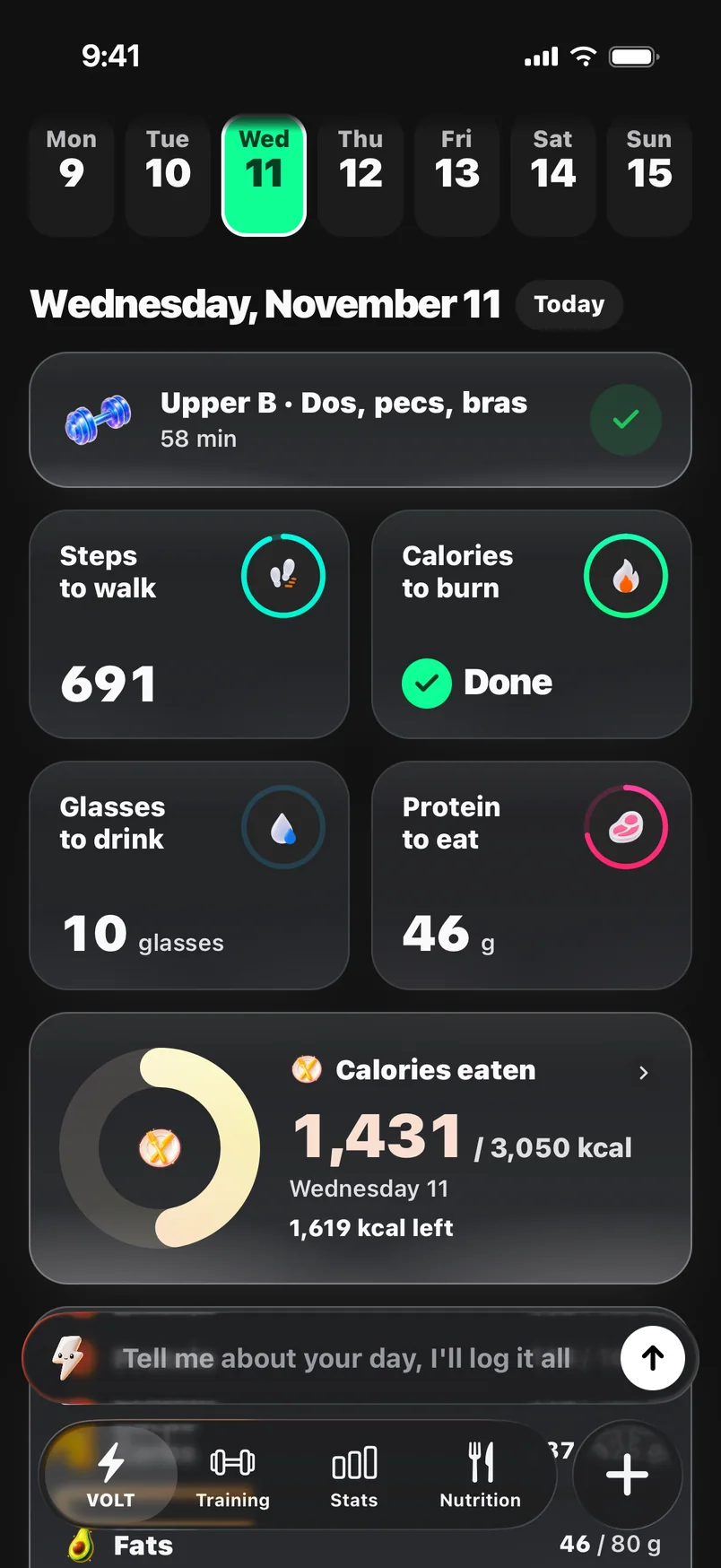
In the 6way app, you give VOLT the date of your half marathon and your current weekly mileage. It writes the full plan, from the following Monday to race day, with the phases, deload weeks, long runs and taper. The server calculates the volumes and workouts from the rules described in this article.
Each workout has a date, and paces as soon as the app knows your MAS or a recent race time. With a connected Garmin watch, running workouts for the next seven days are sent to Garmin Connect and follow any changes to your schedule. If you already follow a strength program, the half marathon plan is added to it and your strength sessions count as the plan's strength work. A missed workout, a busy week or a new race date takes one sentence to VOLT.
Frequently asked questions
For an adult without a federation licence, the medical certificate is replaced by the Pass Prévention Santé from the FFA, the French athletics federation. This entry document is compulsory for all running races in France. You get it online and it is valid for one year from the date it is issued. If you have an illness, are on medication, are pregnant or have a recent injury, talk to your doctor about your half marathon before you start the plan.
Three runs a week are enough for a first half marathon: a long run, a quality workout and an easy run. An intermediate runner moves up to four, two of them quality workouts. An experienced runner does five. At least one day a week has no running. If your schedule only has room for three runs, tell VOLT: it fits the plan to the number of workouts you give it.
In 6way's plans, the long run peaks at 17 km for a beginner, 20 km for an intermediate runner and 23 km for an experienced runner. It never goes over half the week's volume. The full distance is kept for race day. The last full long run comes about two weeks before the race, so you arrive at the start fresh.
Yes. In 6way, your half marathon plan is added to your current strength program, which then counts as your strength work. The generator already includes strength work in the base phase. Put your heaviest leg session well away from the long run and the quality workout, so you run those two on rested legs. In a deload week, the plan's strength work keeps the same exercises with one set fewer.
Yes, if you already run regularly. A 2-hour finish means holding 5:41 per kilometre for the whole race. That corresponds to a MAS of about 12 to 12.6 km/h. A beginner running 20 km a week follows the beginner level: three runs a week, with a long run that builds from 10 to 17 km. If your MAS is lower, keep finishing as your goal and set your target time after your next test. The app converts a recent race time into MAS, then into paces for each zone.