
Hyrox training plan for beginners: how the race works and 12 weeks of training
By Franck Berthelot8 min read
A beginner Hyrox training plan prepares you for the official format, which is 8 runs of 1 km, each followed by a station. That makes 8 km of running and 8 stations in total. Over 12 weeks, the plan starts with a base phase (endurance, strength, station technique), then links runs and stations, and eases off in the final week. Running makes up the biggest part of your finish time, so it takes the largest share of the plan.
How does a Hyrox race work?
A Hyrox race alternates 1 km of running with one station, eight times in a row, in the order set by the official rulebook for the 2026/27 season. The running distance is 8 km in every division. From one division to the next, only the gender and the weights change.
The eight stations, in rulebook order:
- SkiErg: 1,000 m.
- Sled Push: 50 m, in 4 lengths of 12.5 m.
- Sled Pull: 50 m, in 4 lengths of 12.5 m.
- Burpee Broad Jumps: 80 m.
- Rowing: 1,000 m.
- Farmers Carry: 200 m.
- Sandbag Lunges: 100 m.
- Wall Balls: 100 reps.
Hyrox gives an average time of 90 minutes for the race. So the plan prepares you for a long effort, one the organiser compares to a half marathon.
What weights does each division use?
The rulebook has four divisions: Women Open, Men Open, Women Pro and Men Pro. Women Pro carry the same weights as Men Open. The SkiErg, Rowing and Burpee Broad Jumps distances are the same for everyone.
| Station | Women Open | Men Open and Women Pro | Men Pro |
|---|---|---|---|
| Sled Push, sled included | 102 kg | 152 kg | 202 kg |
| Sled Pull, sled included | 78 kg | 103 kg | 153 kg |
| Farmers Carry | 2 × 16 kg | 2 × 24 kg | 2 × 32 kg |
| Sandbag Lunges | 10 kg | 20 kg | 30 kg |
| Wall Balls, 100 reps | 4 kg | 6 kg | 9 kg |
| Wall Ball target height | 2.70 m | 3.00 m (Men Open), 2.70 m (Women Pro) | 3.00 m |
Weights and heights come from the 2026/27 Singles rulebook, table in § 4.1 and § 8.8. These values sometimes change from one season to the next, so check the rulebook for the year of your race.
Why does running matter so much?
Running takes up most of the time in a Hyrox. In the first scientific study of Hyrox, carried out on 11 amateur athletes during a simulated race, the median total time was 86.5 minutes. Running took 51.2 of those minutes and the stations 32.8. The fastest athletes had a higher VO2max and did more endurance training.
The sample is small, but Hyrox makes the same call: its first piece of preparation advice is about running.
That is why three of the five weekly workouts in the 6way beginner Hyrox plan are runs. The station workout has kilometres in it too, since every round ends with 1 km.
How do you split 12 weeks of preparation?
The 6way generator splits 12 weeks into three parts: 5 weeks of base, 6 race-specific weeks, then race week. One week in four is a deload week, at 75% of the volume.
| Weeks | Phase | Content |
|---|---|---|
| 1 to 3 | Base | Zone 2 running, general strength, technique for each station |
| 4 | Base, deload | Volume cut to 75% |
| 5 | Base | Progression picks up again |
| 6 and 7 | Specific | One station then 1 km at race pace, 4 rounds |
| 8 | Specific, deload | Volume cut to 75% |
| 9 to 11 | Specific | Same workout, with running volume at its peak |
| 12 | Race week | 55% of peak volume |
Outside deload weeks, volume rises by no more than 10% from one week to the next. There's a reason for that cap. One study followed 874 novice runners for a year. Those who increased their distance by more than 30% over two weeks seemed more prone to distance-related injuries than those who stayed under 10%. The authors describe their study as exploratory.
What does a typical week look like for a beginner?
The beginner plan has 3 runs, 1 station workout and 1 strength workout a week.
- The long run: 35% of the week's volume, at least 8 km, in zone 2.
- The two easy runs: at least 4 km each, in zone 2.
- Stations: 3 rounds in the base phase, 4 in the specific phase. Each round links a station and 1 km, with a 10-minute warm-up before and a 5-minute cool-down after.
- Strength: deadlift 4 × 5 to 6 and front squat 4 × 6 to 8, then lunges, overhead press, one-arm row and core work.
In the station workout, Wall Balls go from 30 reps in the base phase to 50 in the specific phase, and the other stations stay at 20 reps. The strength workout builds leg and back strength in the gym, which the sled, the lunges and the Wall Balls all depend on.
How do you train to run straight after a station?
You train for it by linking a station and 1 km, as you will on race day. Hyrox advises running after working your legs and arms, in the gym or at home. In the 6way plan, the race-pace kilometre comes in with the specific phase. At least once a week, you run 1 km at race pace straight after each station.
If you have no race date, the app also builds Hyrox workouts in 4-week blocks, the last of them a deload. They alternate runs after stations with station circuits, and if you train three times a week, a workout of 1 km repeats is added. As a beginner, you start with 2 rounds and move up to 3, and each station is set at 40% of your running volume, for example 400 m of SkiErg or 40 Wall Balls.
What should you do in race week?
The final week cuts volume and keeps the intensity. A meta-analysis on tapering puts the most effective drop in volume between 41 and 60%, with no change to intensity or to how often you train. The 6way plan brings this week down to 55% of peak volume, a 45% drop.
Here is the week the app writes:
- Monday: rest day or mobility.
- Tuesday: 20 minutes of easy running and 4 strides.
- Wednesday: light stations, 3 short rounds.
- Thursday: rest.
- Friday: 15 minutes very easy.
- Day before: a carb-rich meal, nothing new.
On race day, start conservatively. Hyrox has seen many participants run a personal best on the first kilometre, and advises finding your rhythm. The 6way plan gives you a simple target. Your fastest and slowest kilometres should be less than 10% apart.
How 6way prepares you for a Hyrox
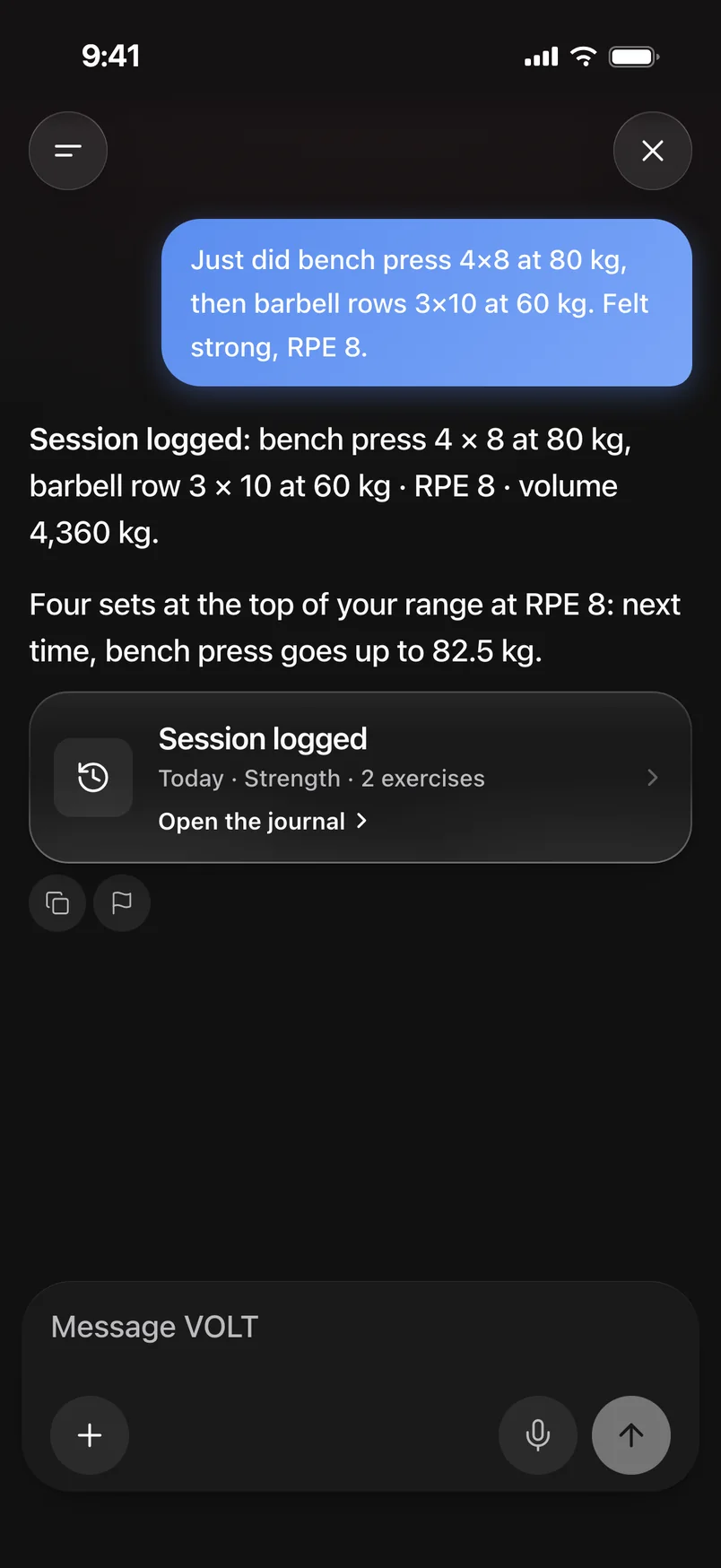
In 6way, you give VOLT the name of your race, its date and your division, and it writes the full plan. The plan starts the following Monday and ends in race week. In station workouts, the sled, the Farmers Carry and the Wall Balls use the weight for your division, and each phase shows its goal.
The Hyrox questionnaire also asks for your goal (discovering the format, finishing, a target time, a podium in your division) and the equipment you have to hand. Every Sunday evening, the app reviews the past week: workouts done, sets, weights, logged effort. It adjusts the next week's strength workout (sets, suggested weight) and leaves completed workouts as they are.
This is the split the 6way generator writes for your race. The 6way app is available on iPhone and Android.
Frequently asked questions
Mostly, yes. Hyrox advises simulating the run-and-station sequence at home or in the gym. You run outdoors for the long run and the easy run. The strength workout needs a barbell and dumbbells. The 6way Hyrox questionnaire asks what equipment you have: a Hyrox-affiliated gym, SkiErg, rowing machine, sled, wall ball, kettlebell or sandbag. Still, get a few sled sessions in before the race. In Women Open, the Sled Push sled weighs 102 kg, sled included.
The 6way Hyrox plan lasts 8 to 12 weeks. If your race is further away, the plan still starts the following Monday and the base phase gets longer, up to a 26-week plan. With less than 4 weeks to go, the app writes a short taper. Either way, the plan ends in race week, with volume cut to 55% of peak.
Hyrox gives an average time of 90 minutes. In the study of 11 amateur athletes in a simulated race, the median time was 86.5 minutes, 51.2 of them spent running. Your time will depend mostly on your endurance. In the same study, the fastest athletes had a higher VO2max and did more endurance training. For a first Hyrox, the 6way questionnaire offers two goals with no target time, 'Discover' and 'Finish'.
Yes, one workout a week in the 6way beginner plan. It targets the legs and back: deadlift, front squat, walking lunges, then overhead press, one-arm row and core work. The sled, the lunges and the Wall Balls work exactly these muscles. Running still takes the largest share of the plan, because in the 2025 study finish time was linked to VO2max and endurance volume. The strength workout adds work on the muscles that the sled, the lunges and the Wall Balls call on.
If you have pain that won't go away, an injury or an illness, or if you are pregnant, ask a doctor before carrying on with the plan. The 6way plan gives you a marker for fatigue. If your resting heart rate is 5 to 10 beats per minute above your normal for three mornings in a row, take two easy days. The effort you log after your sets counts too: on Sunday, the app uses it to set the following week's strength workout.